


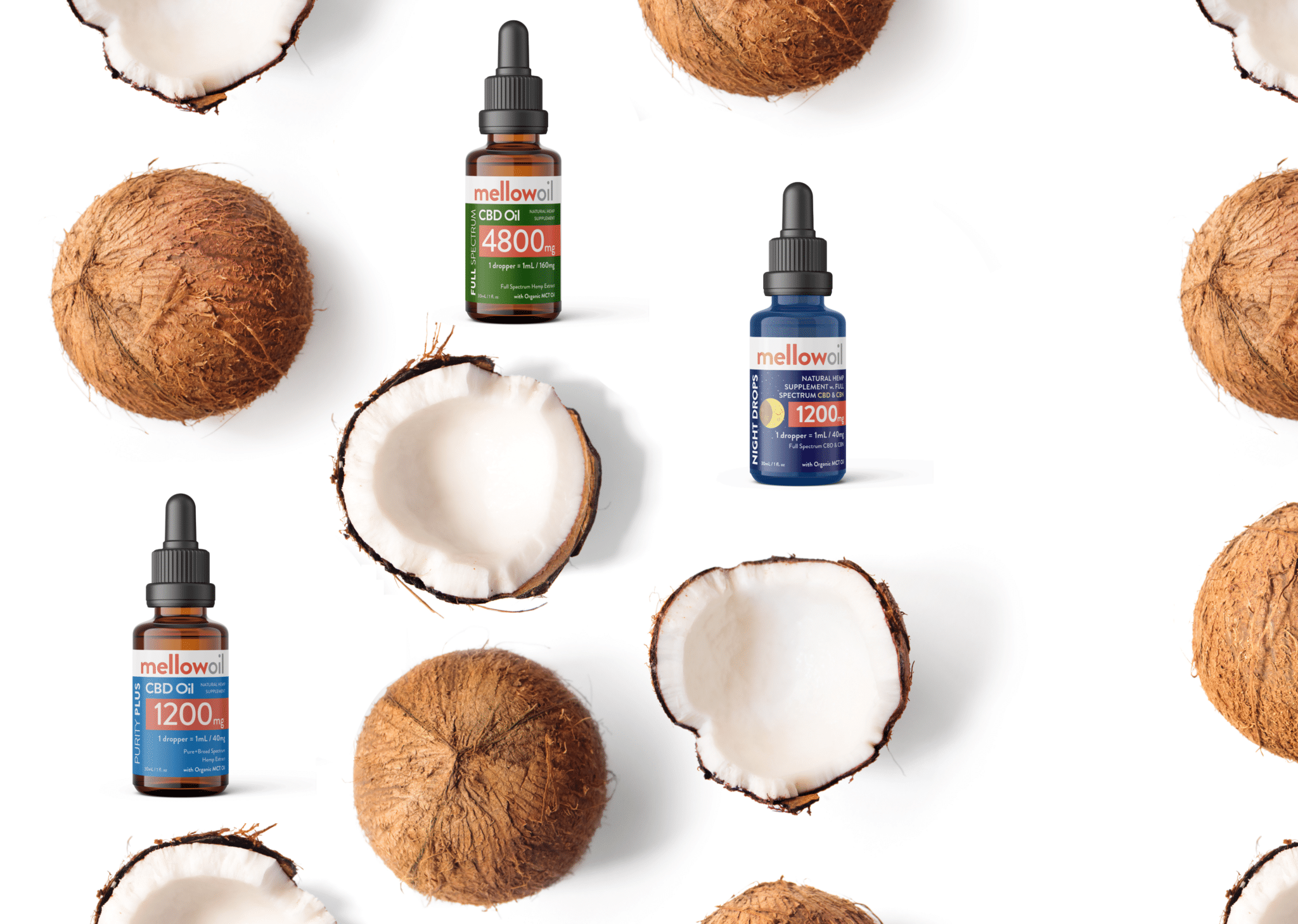
Companies use several different CBD carrier oils for their products, depending on the result they’re going for. When you need to buy CBD Oil in Canada, understanding the formulation including carrier oils is important. Some use MCT oil and CBD, others use hemp seed oil, and still others, like us, use a mixture of both.
TL;DR: The carrier oil in your CBD product directly affects how well your body absorbs it. MCT oil tops the list for bioavailability thanks to its high saturated fat content and small molecule size. Hemp seed oil adds nutrition. At Mellow, we use both to get you the best of each.
Much focus has been put on CBD and its effectiveness, but what many people don’t realize is that the carrier oil in your CBD oil plays a huge part in how bio-available it is; this ultimately affects how well your CBD will work.
But what carrier oil is best for CBD? How do the different carrier oils stack up against each other?
The answer lies in the fat content of the oil. CBD, by nature, is a hydrophobic (water-hating) compound that binds extremely well to fat. Basically, the higher the fat content, the better CBD will bind with it, and the better your body will absorb it.
But there are a few other things that affect this. In this article we’ll look at:
- What CBD carrier oils are
- How CBD carrier oils affect bio-availability
- The best carrier oils for CBD
- Why MCT oil and CBD is the clear winner
By the end of this, you should have a pretty good idea of what to look for and a better understanding of how changing your CBD carrier oil can greatly impact its functions.
What are CBD carrier oils?
To make CBD oil, we extract the CBD from the hemp plant. Raw CBD extract isn’t the ideal way to consume it, which is why it’s mixed with another substance, called a carrier oil.
All CBD oils on the market have a carrier oil. This carrier oil allows for better absorption, even distribution, and more accurate dosing. Carrier oils vary widely between brands, so be sure to read the ingredients list if you’re after a certain one.
The benefits of carrier oils for CBD
Increases absorption of CBD into the body
CBD is a cannabinoid that is fat-soluble. This means that it dissolves easily in fat, not water. Fat-soluble compounds like CBD are best taken with a small amount of fat, whether it’s the cream in your coffee or half an avocado.
Fat-soluble compounds don’t distribute directly into the bloodstream, unlike water-soluble compounds. They instead transform into tiny molecules called micelles.
When you eat fats, the body produces enzymes to help break down these compounds and turn them into micelles. This lets the micelles travel along your lymphatic system, which eventually reaches your bloodstream. Your fatty tissues and liver store any excess that’s left over.
All of the carrier oils used in CBD oil are fat-soluble and chosen for their fat content and effectiveness.
Carrier oils make CBD dosing easier
Dissolving CBD extract into a carrier oil ensures that the product is distributed evenly throughout. When CBD is in its natural form, it would be challenging to measure the exact amount you want to take.
Take CBD Isolate, for example. This form of CBD comes as a fine, crystalline powder; the difference between 50 and 100mg of CBD is negligible to the naked eye. 50mg of it would barely even be visible and extremely difficult to weigh unless you happen to have a precision scale on hand.
When that same amount is added and dissolved in a carrier oil, it’s much easier to dose properly. By mixing one gram of CBD into a carrier oil, you can now precisely measure out, per drop, the amount of CBD you’re getting.
CBD Carrier oils have health benefits all on their own
Many of the most common carrier oils for CBD aren’t just there to help with bio-availability and easy dosing. They also bring several different health benefits of their own.
For example, MCT oil is known for its very long shelf life, and science says it may help reduce heart disease risk. Olive oil is also known for its heart-healthy properties and contains a large number of antioxidants.
How CBD carrier oils affect bio-availability
The bio-availability rate of CBD is the rate that your body absorbs and uses the CBD that you ingest. This rate differs greatly between ingestion methods and can affect how well your CBD works.
When you take CBD sublingually (under the tongue), the bio-availability rate can be up to 35%. This means your body is only going to use approximately 35% of the CBD you took. When you ingest it in the form of capsules or other edibles, the rate drops considerably, as it has to go through your digestive system first.
This is why it matters that you choose a CBD oil with a good carrier, to boost its bio-availability.
Common carrier oils for CBD
While there are many choices on the market for carrier oils, they don’t all measure up in terms of fat content and bio-availability. We aren’t just looking for any fat, but more specifically, saturated fats.
While most experts agree that too many saturated fats in our diets are bad for us, when it comes to a great carrier oil for CBD, higher is actually better.
These are the most common types of carrier oils you’ll see in the CBD industry.
MCT Oil and CBD
MCT oil is far and away the most popular CBD carrier oil for a few different reasons. One, its saturated fat content is very high, around 80%. Two, it’s virtually odourless and tasteless, making it ideal for all sorts of applications.
MCT stands for medium-chain triglycerides. These fat chains are short in length, and because of their small molecule size, they absorb easily into the body. When it comes to CBD, the smaller the molecule, the easier your body absorbs it. This is why nano-CBD has become so popular over the last few years; the particles are much smaller than regular CBD.
MCTs break down directly in the liver, bypassing the usual route through the digestive system. Your body is then able to use it quicker than other oils.
MCT oil is derived mainly from coconuts, although it is sourced from palm trees as well; this is highly damaging to the environment. MCT oil has a shelf life of around two years; you can extend this if properly stored.
Hemp Seed Oil and CBD
Hemp seed oil is another popular carrier oil for CBD, though the shelf life is a lot shorter than MCT. Hemp seed oil, if properly stored, can last up to a year, though this is the high end; once exposed to air and outside elements, this number drops considerably.
Hemp seed oil is, however, one of the most nutritional options for a CBD carrier oil. Rich in vitamins and essential nutrients, hemp seeds are a superfood; science shows it may reduce heart disease, reduce inflammation, and contains antibacterial and antioxidant properties.
Companies will commonly mix both hemp seed oil and MCT oil; this boosts the bio-availability rate and packs a great nutritional punch. CBD oils made with hemp seed oil tend to have more of a classic hempy, earthy taste to them; some people enjoy this, others, not so much.
Many people believe that using oils or tinctures that employ hemp seed oil as the carrier improves the Entourage Effect. This is where all parts of the plant work better together and are more effective than the separate parts. While the research on this isn’t conclusive, it’s still something to consider if you want the “whole-plant” experience.
Olive Oil and CBD
Another option as a carrier oil for CBD is olive oil, though it isn’t as widely used. Olive oil has a larger molecular structure and is, therefore, harder for the body to absorb. It tends to solidify at colder temperatures and has a much stronger flavor that many people find off-putting.
The health benefits of olive oil have been widely studied and may help prevent heart disease and aid in type two diabetes and Alzheimer’s.
Grape Seed Oil and CBD
You won’t find many CBD companies using grape seed oil as a carrier, as it has one of the lowest fat contents on this list. Its makeup consists mainly of polyunsaturated fats and is less than ideal for oils and tinctures.
Instead, it’s used in topical CBD applications, like skin care products or hair care.
Avocado Oil and CBD
One of the thicker oils on the list, avocado oil is also one of the most expensive. It has a light, nutty taste and is more often used in topical applications than oils.
Similar to olive oil in molecule size, avocado oil only has a saturated fat content of about 12%. It’s rich in vitamins A, D, and E and may help to lower cholesterol.
Why MCT oil and CBD is the clear winning combination
With a high-fat content, small molecule size, long shelf life, and health benefits on top of it all, MCT oil and CBD make for a pretty powerful pair. So what does that mean for you practically? It means more of the CBD you take actually gets put to use by your body.
The fact that MCT oil has little to no taste or smell also makes it a strong choice for CBD oil, as companies have full control over how the end product will taste. This eliminates most of the hempy taste of CBD, which some people find very off-putting.
Here at Mellow, we make most of our tinctures with MCT oil and CBD extract, others with a combination of MCT and hemp seed oil to give you the best of both worlds.
References:
https://pmc.ncbi.nlm.nih.gov/articles/PMC6100014/
Sources & External Research
- National Library of Medicine (PubMed): Clinical Studies on Cannabidiol (CBD)
- World Health Organization (WHO): Cannabidiol (CBD) Critical Review Report
Note: Links to external research are provided for informational purposes only and do not constitute medical claims by Buy Mellow.

Comments are closed.