

CBD is getting a lot of attention for its natural support during menopause. One thing stands out though — nearly 80 percent of women experience menopause symptoms severe enough to impact daily life. Most assume powerful changes call for complicated solutions, but the real surprise is how something as straightforward as a non-psychoactive plant compound might help steady the ride through hormonal shifts.
TL;DR: CBD may help ease common menopause symptoms — including anxiety, sleep disruption, joint discomfort, and mood swings — by working with the body’s endocannabinoid system. It’s not a replacement for medical care, but many women find it a useful complement. Results vary, so starting low and checking with your doctor first is the smart move.
Table of Contents
- What Is CBD And How Is It Related To Menopause?
- Why Menopause Symptoms Occur: A Biological Perspective
- How CBD Interacts With The Body’s Endocannabinoid System
- Potential Benefits Of CBD For Menopause Symptoms
- Real-World Perspectives: Experiences With CBD During Menopause
Quick Summary
| Takeaway | Explanation |
|---|---|
| CBD may ease menopausal symptoms | Research suggests CBD can help reduce anxiety, improve sleep quality, and relieve discomfort during menopause. |
| Consult healthcare professionals before use | You’ll want to discuss CBD options with medical experts to make sure the approach fits your individual health needs. |
| Women’s experiences with CBD vary widely | Personal accounts highlight significant differences in CBD effectiveness, making personalised experimentation important. |
| Hormonal changes cause menopause symptoms | Major hormonal shifts during menopause affect physiological functions, leading to a range of systemic changes and symptoms. |
| ECS plays a key role in wellbeing | CBD works with the endocannabinoid system, which helps maintain balance in various bodily functions — potentially benefiting menopausal women. |
What is CBD and How is it Related to Menopause?
Cannabidiol (CBD) is a natural compound from cannabis plants that’s earned real attention for its potential therapeutic properties. Unlike THC, CBD doesn’t produce psychoactive effects, making it an interesting option for women experiencing menopausal symptoms. Learn more about our CBD solutions for menopause.
Understanding CBD’s Biological Mechanism
CBD works with the body’s endocannabinoid system (ECS), a complex cell-signalling network responsible for maintaining physiological balance. According to research from the National Institutes of Health, the ECS plays a key role in regulating various bodily functions, including:
- Mood regulation
- Pain perception
- Sleep cycles
- Hormonal balance
- Inflammatory responses
During menopause, the body goes through significant hormonal shifts that can disrupt these systems — and that’s where CBD may offer some supportive effect.
Potential Benefits for Menopausal Women
Research suggests CBD might help address several challenging menopausal symptoms by potentially:
- Reducing anxiety and mood fluctuations
- Improving sleep quality
- Easing joint and muscle discomfort
- Supporting metabolic health
- Promoting overall emotional well-being
While scientific understanding keeps evolving, women are increasingly looking at CBD as a complementary approach to managing menopausal transitions. You’ll want to consult a healthcare professional and choose high-quality, reputable CBD products matched to your individual needs.
Why Menopause Symptoms Occur: A Biological Perspective
Menopause is a major biological transition marking the end of a woman’s reproductive years, marked by complex hormonal and physiological changes. Learn more about our holistic menopause support — this natural process involves real shifts within the body’s endocrine system.
Hormonal Decline and Reproductive Changes
According to research from the National Institutes of Health, menopause happens when a woman’s ovaries gradually reduce their production of key reproductive hormones. The primary biological mechanisms driving menopausal symptoms include:
- Significant reduction in estrogen levels
- Decreased progesterone production
- Cessation of regular ovarian follicle development
- Disruption of hypothalamic-pituitary-gonadal axis regulation
These hormonal shifts trigger a cascade of physiological responses that show up as recognisable menopausal symptoms, fundamentally altering metabolic and neurological functioning.
The table below outlines the main hormonal changes and their corresponding physiological effects.
| Hormonal Change | Description | Primary Physiological Effects |
|---|---|---|
| Decrease in oestrogen | Gradual reduction in ovarian oestrogen production | Hot flushes, mood fluctuations, bone loss |
| Decrease in progesterone | Lowered production post-ovulation | Sleep disturbances, irregular menstrual cycles |
| Reduced ovarian follicle activity | Cessation of new follicle maturation | End of fertility, menstrual cycle cessation |
| Disruption of HPG axis regulation | Altered hypothalamic-pituitary-gonadal axis signalling | Hormonal imbalance, metabolic and neurological changes |
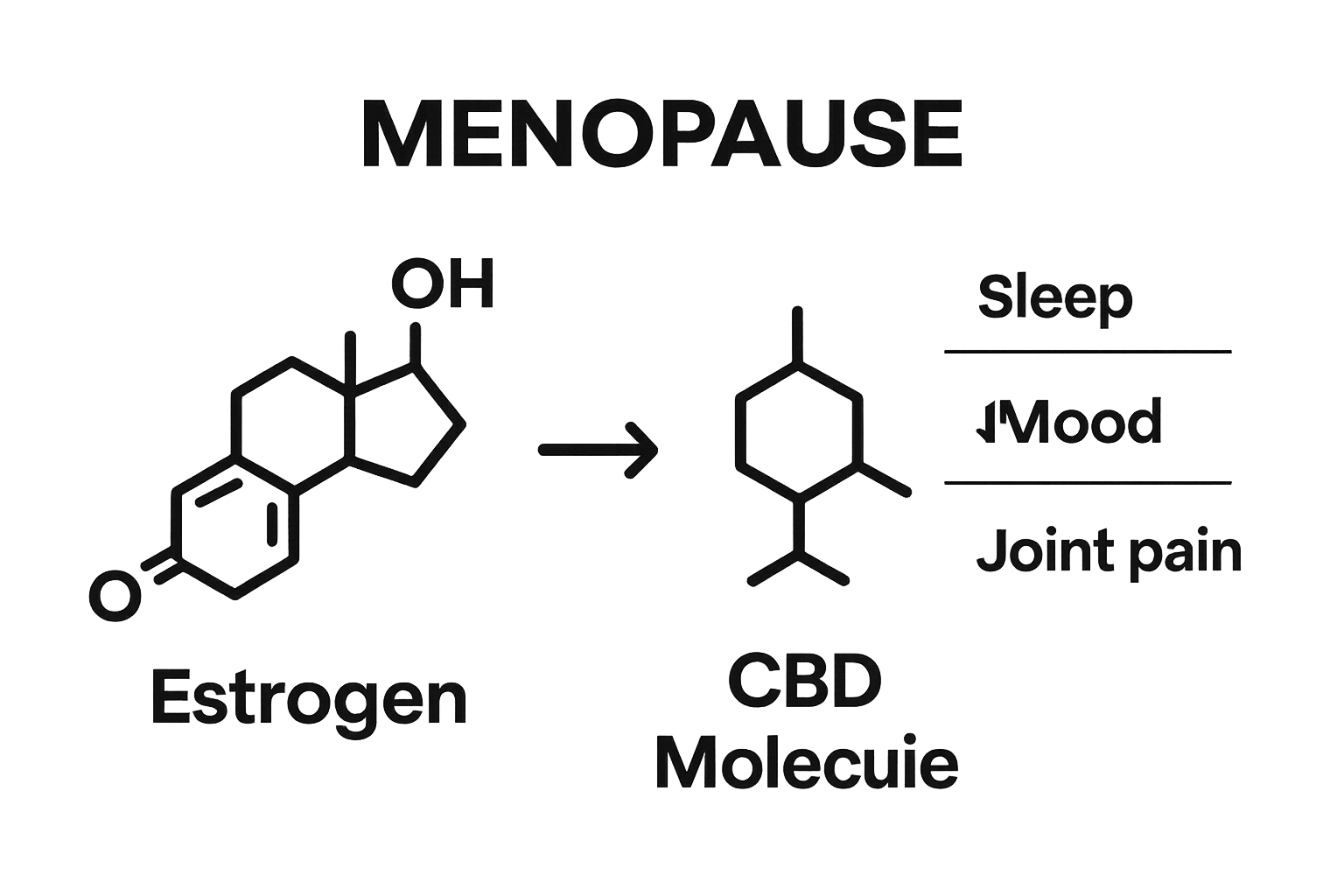
Systemic Impact of Hormonal Transitions
The hormonal decline during menopause goes well beyond reproductive capabilities, affecting multiple bodily systems. Key areas experiencing substantial change include:
- Thermoregulatory system (causing hot flashes)
- Bone density maintenance
- Metabolic processes
- Neurological function and mood regulation
- Skin elasticity and collagen production
Understanding these biological processes helps women approach menopause with greater insight — recognising it as a natural part of life rather than purely a medical problem. Challenging, yes, but also a meaningful milestone.

How CBD Interacts with the Body’s Endocannabinoid System
The endocannabinoid system (ECS) is a sophisticated biological network that plays a key role in maintaining physiological balance. Explore our overview of cannabinoid interactions, showing how this intricate system influences multiple bodily functions.
Receptor Interactions and Molecular Mechanisms
According to research from the National Institutes of Health, CBD works with the body’s cannabinoid receptors — particularly CB1 and CB2 — in a unique way. Unlike THC, it doesn’t directly bind to these receptors but instead modulates their activity through several mechanisms:
- Indirect receptor antagonism
- Allosteric receptor modulation
- Enhancement of endogenous cannabinoid signalling
- Regulation of enzyme activities affecting cannabinoid metabolism
These interactions contribute to CBD’s potential therapeutic effects without producing psychoactive experiences.
Systemic Influence and Regulatory Functions
CBD’s interaction with the endocannabinoid system goes beyond simple receptor engagement. The compound shows real potential in influencing various physiological processes by:
- Supporting neurological balance
- Easing inflammatory responses
- Regulating stress and anxiety pathways
- Promoting cellular stability
- Potentially supporting hormonal balance
Understanding these interactions highlights the nuanced role CBD might play in supporting overall wellness — particularly during transitional periods like menopause.
Potential Benefits of CBD for Menopause Symptoms
Menopause brings complex physiological challenges that can significantly affect a woman’s quality of life. See our latest insights on menopause management, looking at how CBD might offer supportive therapeutic potential during this significant life transition.
Addressing Emotional and Psychological Symptoms
According to research from Rutgers University, CBD shows promising potential in managing the psychological side of menopause. Women frequently deal with emotional challenges during this period, including:
- Persistent anxiety
- Mood volatility
- Increased stress sensitivity
- Sleep disruptions
- Cognitive fluctuations
CBD’s interaction with neurotransmitter systems suggests it might help modulate these emotional responses — offering a natural approach to emotional regulation. How do you choose where to start? From what we’ve seen, sleep and anxiety tend to be the areas where women notice results first.

Physical Symptom Management
Beyond emotional support, CBD may offer benefits for physical menopausal symptoms too. Emerging research points to potential advantages in managing:
- Inflammatory responses
- Joint and muscle discomfort
- Metabolic changes
- Bone density maintenance
- Thermoregulatory function
More clinical studies are still needed, but the preliminary evidence suggests CBD could be a useful complementary approach alongside conventional menopause management strategies. Women considering CBD should talk to a healthcare professional to find the most appropriate and personalised route.
The table below summarises the main menopause symptoms discussed and indicates whether CBD shows potential influence, based on current research and reported experiences.
| Symptom | Potential Influence of CBD | Supporting Information in Article |
|---|---|---|
| Anxiety and mood fluctuations | Possible alleviation | CBD may help reduce anxiety and mood changes |
| Sleep disturbances | Might improve sleep quality | CBD associated with better sleep in studies |
| Joint and muscle discomfort | Can provide relief | Women report improvement with CBD use |
| Hot flushes/thermoregulation | Potential supportive effect | Emerging research suggests possible benefit |
| Bone density loss | Unclear/under research | Preliminary evidence, more studies needed |
| Inflammatory discomfort | Likely to help | CBD noted for anti-inflammatory properties |
Real-World Perspectives: Experiences with CBD During Menopause
Menopause is a deeply personal journey that looks different for every woman, with each person facing unique challenges and finding different solutions. Explore our cannabinoid overview to understand how real women are working through this transition.
Subjective Symptom Management
According to a qualitative study on midlife women, personal experiences with CBD during menopause reveal nuanced perspectives on symptom management. Women in the research consistently reported varied but interesting outcomes, highlighting several key observations:
- Individual responses to CBD differ substantially
- Symptom relief isn’t universal or guaranteed
- Personal experimentation plays a key role
- Dosage and product quality significantly affect results
- Lifestyle factors interact with CBD’s potential benefits
These findings underline the importance of personalised approaches and careful, informed decision-making when considering CBD as a potential support tool.
Sorting Out Challenges and Expectations
Women looking at CBD during menopause often find themselves working through a lot of conflicting information. Their experiences typically involve:
- Limited medical guidance
- Self-directed research and learning
- Cautious experimentation
- Balancing expectations with realistic outcomes
- Seeking community support and shared experiences
While scientific research is still evolving, personal accounts give real insight into the potential role of CBD during this major life transition. Women are encouraged to approach CBD use thoughtfully, consult healthcare professionals, and keep open, honest conversations about what they’re experiencing.
Take Control of Menopause with Personalised CBD Wellness
Menopause comes with real challenges. If you’re dealing with mood changes, disrupted sleep, or physical discomfort as described in this post, you deserve relief that fits your life. By supporting your body’s endocannabinoid system, CBD offers a gentle and natural way to ease common symptoms and help restore your sense of balance. Find trusted Canadian CBD wellness options in our Health collection to start your path toward comfort and calm.

At Mellow, we’ve worked with a lot of women who’ve found real improvement by adding CBD to their routine — and we’ve seen how much the right product and the right dose can matter. Explore safe and effective CBD products made with health-focused women in mind. Don’t settle for feeling out of control. Visit Buy Mellow now and see how plant-based support can make your daily transition smoother. Your path to better days starts here.
Frequently Asked Questions
What is CBD, and how does it relate to menopause?
CBD (cannabidiol) is a natural compound from cannabis plants, known for its potential therapeutic properties without psychoactive effects. It may help ease various menopausal symptoms by working with the body’s endocannabinoid system, which regulates mood, pain perception, and hormonal balance.
How can CBD help with menopause symptoms?
Research suggests CBD may help manage several menopausal symptoms, including anxiety, mood fluctuations, sleep disturbances, joint discomfort, and overall emotional well-being. Individual experiences vary, so talking to a healthcare professional is recommended.
Are there any side effects of taking CBD during menopause?
While CBD is generally considered safe, some people may experience mild side effects, such as fatigue, changes in appetite, or digestive issues. Start with a low dose and monitor your body’s response, and check with a healthcare professional if you have any concerns.
How should I take CBD for menopausal symptoms?
CBD comes in various forms, including oils, capsules, edibles, and topicals. Choose a method that fits your preferences and lifestyle, and make sure the product is high quality and matched to your specific needs.
Recommended
Sources & External Research
- National Library of Medicine (PubMed): Clinical Studies on Cannabidiol (CBD)
- World Health Organization (WHO): Cannabidiol (CBD) Critical Review Report
Note: Links to external research are provided for informational purposes only and do not constitute medical claims by Buy Mellow.