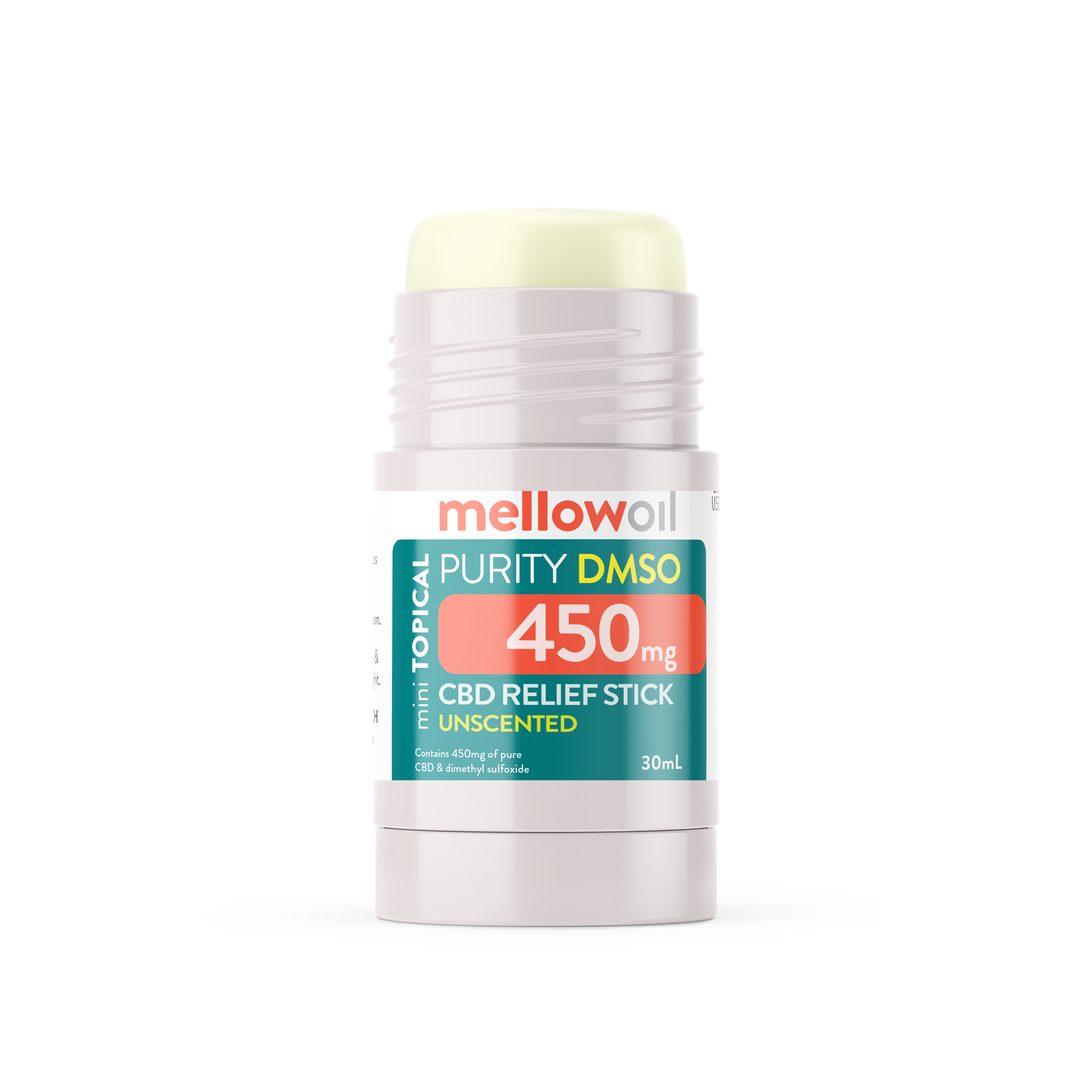
Education · Topicals
DMSO and CBD: How They Work Together for Better Topical Absorption
By Mallory Milne · Updated April 2026 · 8 min read
CBD topicals work — but their Achilles heel is absorption. Cannabidiol molecules are large and fat-soluble, which limits how deeply they penetrate the skin barrier on their own. DMSO (dimethyl sulfoxide) changes that equation. It's one of the most studied transdermal penetration enhancers in pharmaceutical research, and when combined with CBD, it can meaningfully increase how much cannabidiol actually reaches the tissue below the skin.
Here's what DMSO is, how it works, how to use it safely with CBD, and what to watch out for.
What Is DMSO?
DMSO is a naturally occurring compound derived from wood pulp, produced as a byproduct of paper manufacturing. It's been used in pharmaceutical and medical research since the 1960s — the FDA approved it for treating interstitial cystitis (bladder inflammation) in 1978, and it's been widely used as a carrier and solvent in drug delivery research ever since.
Its most distinctive property: DMSO penetrates biological membranes rapidly and carries other molecules with it. Applied to skin, it passes through the stratum corneum — the outer barrier layer — in minutes, dragging dissolved compounds into the dermal layers below. This is what makes it valuable as a delivery vehicle.
The trade-off is its characteristic odour. DMSO is metabolized in the body to dimethyl sulfide, which produces a noticeable garlic-like smell from the breath and skin within 30–60 minutes of application. At lower concentrations (under 30%), the odour is significantly reduced.
Why CBD Topicals Benefit From a Penetration Enhancer
Standard CBD topicals — creams, balms, relief sticks — work primarily in the upper layers of the skin. The cannabidiol interacts with local CB1 and CB2 receptors in the epidermis and upper dermis, providing localized effect. This is useful, but the depth is limited.
DMSO as a carrier pushes that boundary. It can carry CBD past the stratum corneum barrier and into the deeper dermis and subcutaneous tissue — reaching muscles, joints, and connective tissue that standard topical formulations can't reliably access. This is particularly relevant for joint support and deeper muscle recovery applications.
DMSO Absorption — How It Compares
The table below summarizes the key variables across topical delivery methods. Note that human bioavailability data for DMSO+CBD specifically is limited — these figures reflect established DMSO penetration research combined with general transdermal CBD data.
| Application Method | Penetration Depth | Onset | Duration | Odour |
|---|---|---|---|---|
| Standard CBD topical | Epidermis only | 20–40 min | 4–6 hrs | None |
| DMSO alone (topical) | Dermis + subcutaneous | 10–20 min | 4–6 hrs | Strong garlic |
| DMSO + CBD topical | Dermis + subcutaneous | 10–20 min | 4–6 hrs | Mild–moderate* |
| CBD sublingual (tincture) | Systemic | 15–45 min | 4–6 hrs | None |
| CBD capsule / oral | Systemic (lower bioavail.) | 45–90 min | 6–8 hrs | None |
*Odour at <30% DMSO concentration. Sources: DMSO transdermal penetration literature; general transdermal CBD pharmacokinetic data. Human clinical data for DMSO+CBD specifically is limited.
How to Use DMSO and CBD Together Safely
The most important rule with DMSO: it carries everything on your skin into your body. Applied to contaminated or dirty skin, DMSO will pull those contaminants transdermally. Clean skin is non-negotiable.
- Clean and dry the area completely. Wash with soap and water, rinse thoroughly, and dry before applying anything.
- Use clean hands or a clean applicator. Don't touch the product or skin with hands that have been in contact with lotions, cleaning products, or anything else.
- Apply to a small test area first. Especially on first use. Watch for 15–20 minutes for any irritation or sensitivity before wider application.
- Don't layer other products on top immediately. Wait at least 30 minutes before applying anything else to the treated area — DMSO can carry those compounds in too.
- Start with a lower concentration product. At under 30% DMSO, odour is significantly reduced and skin tolerance is generally better.
Side Effects to Know
DMSO is well-tolerated by most people at standard topical concentrations, but the side effect profile is worth understanding before first use:
- Garlic odour from breath and skin — begins 30–60 min after application, typically clears within a few hours. At lower DMSO concentrations this is significantly reduced.
- Skin warmth or tingling at the application site — normal, typically mild.
- Redness or irritation at higher concentrations or with prolonged use on sensitive skin.
- Avoid use during pregnancy — DMSO crosses the placental barrier.
- Contraindications with certain medications — because DMSO enhances absorption of everything, it can increase the effect of medications applied to or near the skin. If you take prescription medications, consult a healthcare provider before use.
The Benefits of Combining DMSO and CBD
For the right applications, the combination addresses the core limitation of standard CBD topicals:
- Greater penetration depth — reaches deeper tissue that standard carriers can't reliably access
- Faster onset — DMSO moves through the skin barrier significantly faster than lipid-based carriers
- DMSO's own anti-inflammatory properties — it has documented anti-inflammatory activity independent of any compound it carries, so the combination provides a dual mechanism
- No flavour or taste impact when used topically (unlike oral CBD)
The applications that make the most sense: joint discomfort, deeper muscle soreness, and any condition where localized application depth matters more than broad systemic coverage. For systemic effects, a full spectrum CBD tincture remains the better format.
Using CBD Isolate With DMSO — The Zero-THC Option
If you want to make your own DMSO+CBD topical, CBD isolate powder is the cleanest base. It's 99%+ pure CBD — no THC, no plant waxes, no other cannabinoids — and it dissolves readily in DMSO. Dissolve the isolate in a small amount of MCT oil first, then combine with DMSO at your desired ratio. This gives you full control over both the CBD concentration and the DMSO percentage.
For athletes and professionals subject to drug testing, isolate-based topicals with DMSO are the safest format — zero THC risk, and topical application doesn't meaningfully affect blood cannabinoid levels.